Continuous Glucose Monitors, often called CGMs, are small wearable devices that track glucose levels throughout the day and night. Instead of taking a single blood sugar reading like traditional finger-stick tests, a CGM provides continuous data that shows how glucose levels rise and fall over time.
A continuous glucose monitor (CGM) is a small wearable device that tracks glucose levels throughout the day, helping people better understand how their body responds to food, activity, and daily habits.
Originally developed for people with diabetes, CGMs have become one of the biggest advances in blood sugar monitoring. They allow users to see patterns in their glucose levels and better understand how food, activity, stress, and sleep affect their metabolism.
In recent years, interest in CGMs has grown beyond diabetes care. Many people are now exploring this technology as a way to learn more about their metabolic health and how their body responds to different foods and habits.
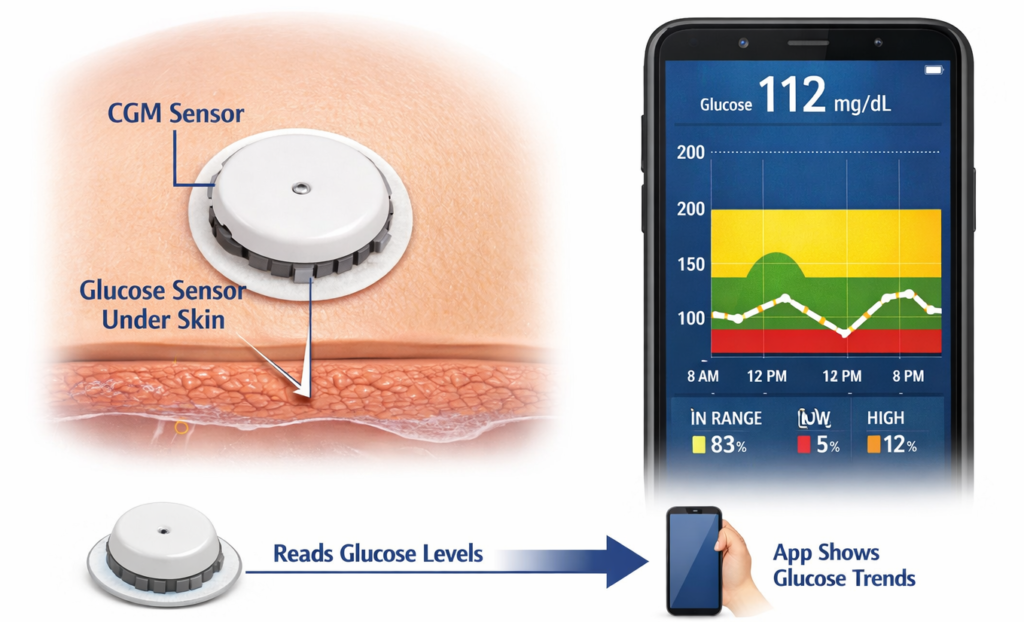
A continuous glucose monitor (CGM) sensor sits just under the skin and sends glucose readings to a smartphone app.
How a Continuous Glucose Monitor Works
A continuous glucose monitor (CGM) uses a small round sensor that is placed just under the skin, most commonly on the back of the arm or sometimes on the abdomen.
The sensor measures glucose levels in the fluid between cells. Every few minutes, it sends that information wirelessly to a receiver or smartphone app.
Instead of seeing just one number at a time, users can view a graph of glucose trends throughout the day. This makes it easier to notice patterns such as:
- how glucose changes after meals
- how exercise affects blood sugar
- how stress or sleep may influence glucose level
For people managing diabetes, this information can help guide treatment decisions. For others, it can simply provide insight into how their body responds to everyday choices.
From Prescription Devices to Over-the-Counter CGMs
For many years, CGMs were available only with a prescription and were used almost exclusively by people with diabetes.
Getting one typically involved a doctor’s visit and insurance approval. Because of the cost, insurance coverage was often necessary for long-term use.
Recently, however, new over-the-counter (OTC) CGMs have started becoming available. These devices are designed for people who want to better understand their glucose patterns even if they do not have diabetes.
The goal of these newer devices is not medical treatment but personal metabolic awareness. Many people are curious about how their body responds to certain foods, how their glucose levels change during exercise, or why their energy fluctuates throughout the day. CGMs provide a way to observe those patterns in real time.
Does a CGM Have a Needle?
One of the first questions people ask is whether waiting a CGM involves a needle. A small applicator is used to insert the sensor, but what actually stays under the skin is a tiny flexible filament, not a traditional needle. Most people describe the insertion as a quick pinch that lasts only a moment.
Once the sensor is in place, it continuouslyr measures glucose levels without the need for repeated finger-stick testing.
How Long Can You Wear a CGM?
Most CGM sensors are designed to be worn for about 10 to 14 days, depending on the brand.
During that time, the device continuously collects glucose readings and sends them to the connected smartphone app. When the sensor reaches the end of its wear period, it is removed and replaced with a new one.
The sensors are generally water resistant and can usually stay on during normal activities such as showering, exercising, and sleeping.
How Much Does a CGM Cost?
The cost of a CGM depends on the type of device and whether it is prescribed for medical use.
Prescription CGMs used for diabetes management can cost hundreds to several thousand dollars per year without insurance, although many insurance plans cover them for people with diabetes.
Newer OTC CGMs designed for personal glucose tracking are typically purchased directly by consumers and may cost around $75 to $150 per month, depending on the brand and program.
Some people are able to use Health Savings Accounts (HSA) or Flexible Spending Accounts (FSA) to help pay for CGM sensors, which can help offset the cost.
Why People Are Becoming Interested in CGMs
The growing availability of CGMs represents an interesting shift in personal health technology. What began as a specialized device for diabetes care is now becoming a tool that many people are exploring to better understand their metabolism and eating habits.
For individuals who have struggled with weight management or energy fluctuations, seeing real-time glucose patterns can provide useful insight into how the body responds to different foods and lifestyle choices.
Understanding these patterns can help people make more informed decisions about nutrition, activity, and overall health.
Learning More About CGMs
If you’re just starting to learn about continuous glucose monitors, it can take a little time to understand what the numbers mean and how to use the information in a helpful way. Many people find that having some guidance makes the process much easier.
As I continue learning and experimenting with CGMs myself, I’ll share what I discover along the way and point you toward helpful resources that explain how to use this technology to better understand your metabolism and daily habits.
Are You Thinking About Using a CGM?
Continuous glucose monitors are opening the door for many people to better understand how their body responds to food, activity, and daily habits.
If you’re curious about using a CGM, you’re not alone. Many people are exploring these devices to better understand their glucose patterns and how lifestyle choices affect their energy and well-being.
I’d love to hear from you.
Are you thinking about trying a CGM?
What are your goals or reasons for wanting to use one?
Leave a comment below and share what you’re hoping to learn.