I started using a continuous glucose monitor (CGM) because I wanted more insight into why I wasn’t losing weight.
I purchased a program right away because I wanted help understanding what I was looking at and how to use the information effectively. I wasn’t interested in wearing a CGM just to collect data. I wanted to use it as a tool to help me make better choices and support my weight loss efforts.
Affiliate Disclosure: This post may contain affiliate links, which means I may earn a commission if you purchase through these links, at no extra cost to you. I only share products and programs I personally use or believe may be helpful. Read my full Affiliate Disclosure here.
Medical Note: This content is for educational purposes only and reflects my personal experience and research. It is not medical advice. Always consult your healthcare provider before making health decisions based on this information. Read my full Medical Disclaimer here.
One thing I’ve learned is that using a CGM for weight loss is not about staring at your app all day — even though I definitely found myself obsessing over what I was seeing the first couple of weeks.
At first, I was checking it all the time because I was curious and trying to understand what I was seeing. But over time, I realized it was more helpful to focus on a few basic numbers and notice patterns.
Those patterns can help you see which foods seem to keep you steadier, which meals may leave you hungrier later, and how things like stress, poor sleep, illness, or movement may affect what you see.
You do not have to understand everything all at once.
If you’re using a CGM as a weight loss strategy, here are 5 things that may be worth paying attention to.
1. Your current glucose reading
This is the number you’ll probably notice first.
It gives you a snapshot of where your glucose is at that moment. On its own, it does not tell you everything, but it can still be helpful when you look at it in context.
For example:
- What was it before you ate?
- What does it look like an hour or two after a meal?
- Did it stay fairly steady, or did it rise quickly?
It’s normal for blood sugar to go up after you eat. What I think is more helpful to notice is how high it goes and how long it takes to come back down.
For weight loss, I think this matters because it can help you become more aware of how your body responds to meals and snacks. Sometimes we think a food is working well for us, but the CGM may suggest otherwise.
That does not mean one number should make you panic or that one meal tells the whole story. It just gives you another piece of information you can use.
2. Whether your glucose is rising, falling, or staying steady
This is one of the things that makes a CGM different from a single glucose check.
You’re not just seeing a number. You’re also seeing what direction things are moving.
That can be really helpful for weight loss because two similar readings can mean different things depending on what happens next.
A number that is staying steady may suggest your meal was more balanced for you.
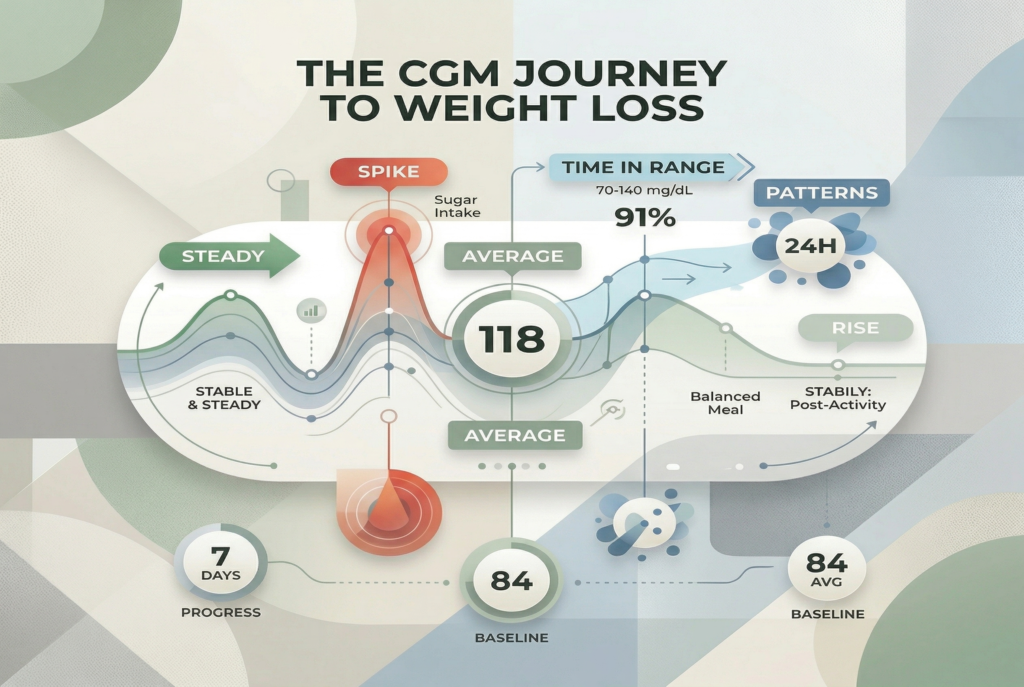
A number that is climbing quickly may be a sign that the meal affected you more strongly than you expected. That’s where people often start talking about a spike.
Again, it is normal to see glucose rise after eating. What matters more is whether it shoots up quickly, goes higher than expected, or stays elevated for a while before coming back down.
I also think it’s worth paying attention when your glucose rises and it is not connected to a meal.
That can be a reminder that food is not the only thing affecting your numbers. Stress, poor sleep, illness, movement, and other everyday factors can all play a role. For me, that has been one of the most eye-opening parts of using a CGM.
3. Your time in range
Time in range gives you a bigger-picture look at how much time your glucose is staying within the range your app is using.
What I like about this number is that it helps you zoom out.
If you only look at random readings here and there, it is easy to get overly focused on one moment. Time in range gives you a broader view of how things are going overall.
Each app may show this a little differently. Some use a target range, some use a personalized zone, and some use their own scoring system. I think the main thing is to notice what your app considers your usual or recommended range and then watch for patterns over time.
That can still be helpful when you’re trying to lose weight because progress is usually about patterns, not one isolated number.
Maybe one meal was higher than you expected. That happens.
But if you’re seeing that overall you’re spending more time in a steadier range, that may be more meaningful than focusing on one rise.
I think this number can also help you notice whether small changes are making a difference.
Maybe you added more protein to breakfast.
Maybe you took a short walk after dinner.
Maybe you changed the order you eat your food.
Those small habits may start to show up in the bigger picture over time.
4. Your average glucose
Average glucose is another number that helps you step back and look at trends.
I like this because it keeps me from getting too caught up in minute-by-minute changes.
A CGM gives you so much information that it can start to feel noisy if you are not careful. Average glucose helps simplify things a little.
When you’re using a CGM for weight loss, this can be a helpful way to ask:
- Am I seeing any improvement over time?
- Do my usual meals seem to be working for me?
- Are some of my habits helping me stay steadier overall?
It is not about making every day look exactly the same. It is about looking at the direction things seem to be moving.
For weight loss, I think that broader view is often more useful than reacting emotionally to every reading.
5. Your post-meal rise
If I had to pick one area that feels especially useful for weight loss, this would probably be it.
A lot of the value of a CGM comes from seeing what happens after you eat.
This is where you may start to notice things like:
- a breakfast that leaves you surprisingly high and hungry again later
- a meal that looks healthy on paper but does not seem to keep you steady
- a more balanced meal that gives you a calmer response
- how movement after eating may help
This does not mean you need to turn every meal into an experiment.
It just means paying attention.
You might start to notice that one breakfast keeps you full and steady, while another seems to lead to more cravings later.
You might find that a meal with more protein, fiber, or fewer refined carbs works better for you.
You may also notice that not every rise is about food. Stress, sleep, illness, and other everyday factors can affect your numbers too.
For me, this is where the CGM starts to become more than just a gadget. It becomes feedback.
Why these numbers matter for weight loss
What I like about focusing on these five things is that they help make the data feel more useful and less overwhelming.
Instead of wondering what every graph means, you can come back to a few simple questions:
- Where am I right now?
- Which direction am I going?
- How steady am I overall?
- What are my usual patterns?
- What tends to happen after I eat?
That is enough to start learning a lot.
And for weight loss, that kind of awareness can be powerful.
It may help you make better food choices.
It may help you notice what keeps you fuller longer.
It may help you see whether a little movement changes your response.
It may help you connect the dots between habits and results.
That is really how I think about a CGM for weight loss. Not as a magic solution, but as a tool that can give useful feedback.
When you want more help
I’ll also say this honestly: even though I wanted to use a CGM for weight loss, I knew from the beginning that I did not want to figure it all out by myself.
That is why I purchased a program right away.
I wanted help understanding the patterns, what to pay attention to, and how to use the information in a way that actually made sense in real life.
If you feel that way too, I wrote more about different CGM programs for weight loss and the kinds of support they offer. The program I chose is Glucose Insiders Academy.
You can learn more about Glucose Insiders Academy here.
Final thoughts
Using a CGM for weight loss does not mean you need to become an expert in every graph and every data point.
I think it helps to start simple.
Focus on a few basic numbers.
Notice what seems to happen after meals.
Watch for patterns over time.
Use what you learn to make small adjustments.
That is where a CGM can start becoming a helpful weight loss tool instead of just more information on a screen.
Comment below what number you’re working on!!